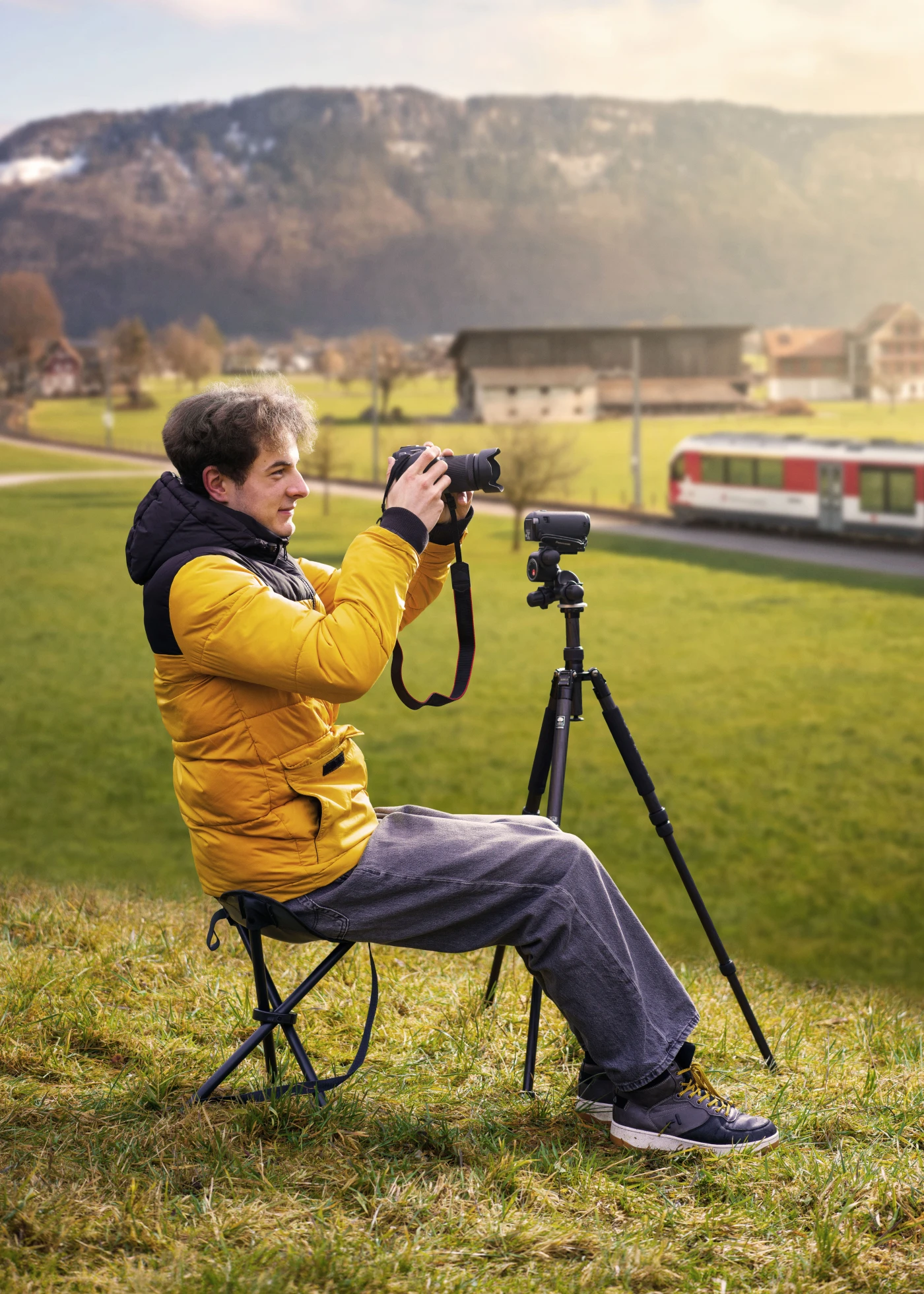
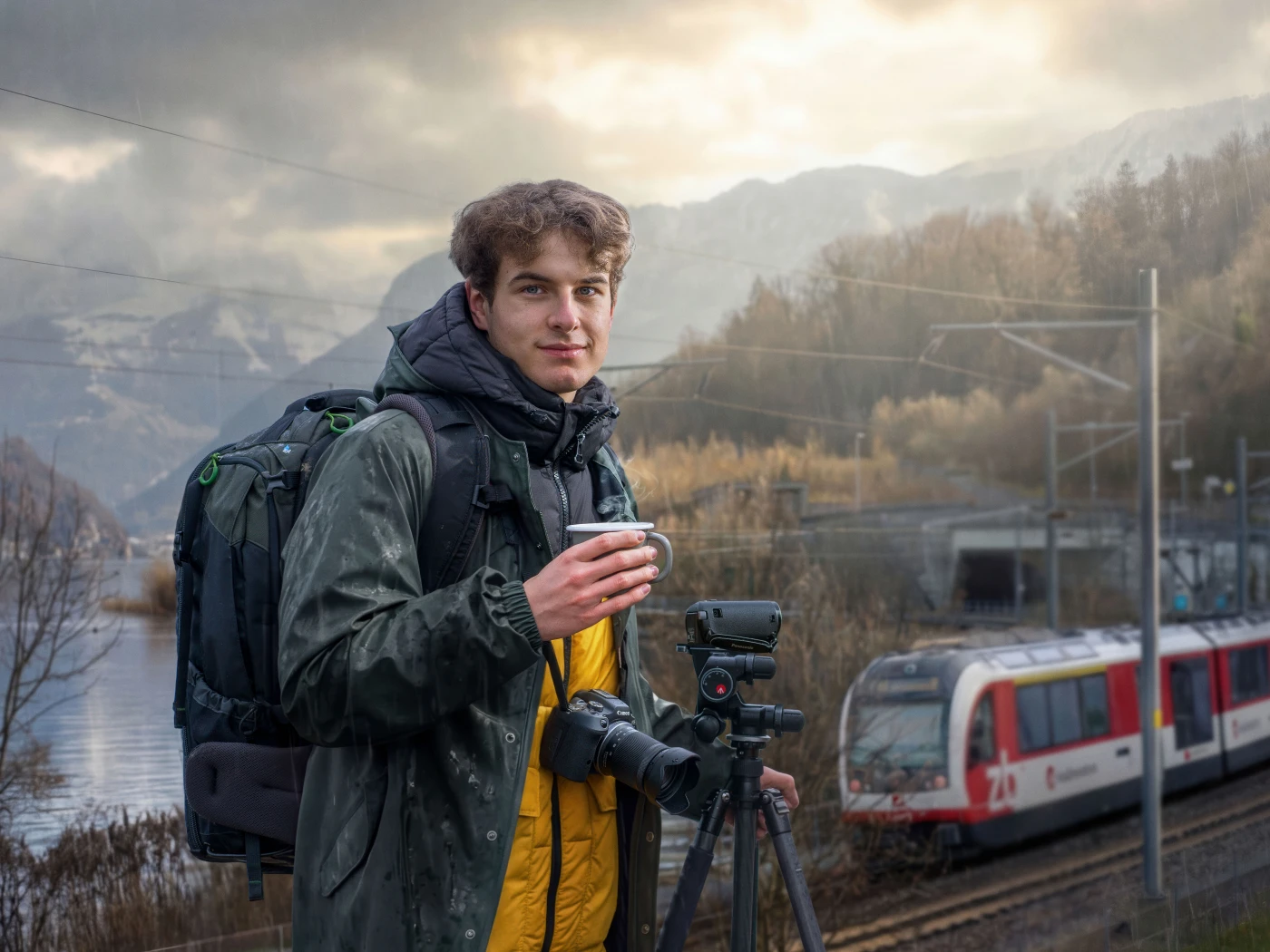
Sven, a passionate photographer and filmmaker of trains.
Stories24.03.2026Aline Rüedi
Sven captures what is often only visible for a brief moment: special and sometimes rare train formations. With great passion and a keen sense of timing, he shares his fascination for railways and makes it tangible for others.
For Sven, nothing is more fulfilling than pursuing his passion: capturing particularly beautiful and sometimes rare historic train formations and making them accessible to others by sharing his work on social media. «It all started when I was a little boy. I travelled to Oberdorf with a camera in one hand while my grandmother held the other, and that’s where I took my first photos of trains. They’ve never left my mind since.» Over the years, not only has Sven’s curiosity grown, but so has his equipment, which is now more extensive and, above all, more professional. For good reason:
«For my subjective perspectives, I need more than just one lens.»
Few people fit the description «railway photographer» better. Sven’s great passion is tracking down, photographing and filming trains, including particularly interesting ones from Zentralbahn: «I’m out almost every weekend, and of course my camera is always with me.» However, anyone who thinks Sven simply relies on luck would be mistaken. He plans his expeditions down to the smallest detail «even chance itself,» he adds with a smile. This is because his main interest lies in historic trains, which are not out on the tracks every day but spend most of their time in sheds, depots or sidings. Zentralbahn also preserves several rare examples of historic locomotives, which for Sven are «very special treasures from the early days of electrification» of the rail network.
«I’m out almost every weekend.»
But how does he find out which locomotive or formation is running, and when and where? On the one hand, Sven maintains active exchanges with like minded enthusiasts, mainly via social media, and sometimes even meets them for joint photo excursions, which can last several days. He is also familiar with many associations, regularly checks their websites and finds out about upcoming special trips: «Some even create calendars, which naturally makes my planning easier.» Online, Sven also finds maps showing relevant railway lines. On some of them, individual points can be clicked to reveal what the location looks like. Another important factor in his planning is the weather, especially the position of the sun. Only then can the perfect shot be achieved. But what happens to all the material once the photos are taken, the filming is done and the adrenaline in Sven’s veins has settled? He shares the results of his research and his photo and film work on relevant platforms. He does not keep his «hot spots» with high Instagram potential to himself like a truffle hunter would:
«I don’t do this just for myself.»
What he wants most is for as many people as possible to share in his fascination for railways. Sven therefore prefers to describe himself modestly and calmly as a «railway photographer.» He rarely uses the trendy term «trainspotter» and never for himself.
Thank you, Sven. We travel well with you.
YouTube Video
Sven's «Lokipedia»
«Makrofon» is the technical term for a train’s horn or whistle. In everyday language, it is often simply called «Makro.» Some people distinguish between a whistle and a Makro, with «Makro» typically referring to an air powered horn. Some railway fans move their arm up and down to signal to the train driver that they should sound the horn for them; this is known as a «Makro arm.» Within the community, this behaviour is generally unpopular and not well regarded.
A brake shoe is a metal wedge weighing around 6 kilograms that is placed on the rails to slow down and stop rail vehicles through friction as they pass over it. It is mainly used during shunting operations and is similar to wheel chocks used on roads.
A signal provides clear instructions to train drivers and ensures safe railway operations. It indicates whether to proceed, slow down or stop. This gives the driver continuous guidance about the track ahead.
In addition to the many signals, there are small dwarf signals. These are black, triangular and equipped with three lights. They are used for shunting movements. If the lights are horizontal, it means «Stop!». If they are diagonal, it means «Proceed with caution» (the next dwarf signal shows «Stop!»). If they are vertical, it means «Proceed». Shunting movements are allowed to pass a main signal showing red if the dwarf signal indicates proceed.
Track gauge refers to the distance between the rails. SBB and most European countries use standard gauge, where the rails are 1.435 metres apart. Zentralbahn, on the other hand, uses metre gauge, meaning the distance between the rails is exactly one metre. As a result, SBB trains cannot operate on these tracks. This makes Zentralbahn a narrow gauge railway. Metre gauge is particularly practical in mountainous regions, as it allows for tighter curves and steeper routes, making it ideal for Zentralbahn and especially for the Brünig line.
Nowadays, almost all tracks are continuously welded. In summer, high temperatures can cause the rails to expand and slightly deform. In the case of track buckling, the stress becomes so great that the rails shift and may bend out of the ballast bed. To prevent this, sections of the rails along the Zentralbahn route are painted white in certain areas, making them less susceptible to heat (something some people may also have seen in Italy).
Quiz with Sven
This site is protected by reCAPTCHA.